About us
Cleriqa began inside Onwards Capita, a CFO execution firm, not in a software lab. Over the years, we worked with SMEs that had accounting data, reports, and dashboards, but still lacked clear answers to the questions that mattered most:
“How much cash is really free? What is coming next? What should we do now?”

We stopped treating this as a pure SME software problem.
At the same time, we saw accounting firms facing the opposite side of the same problem. They had the data, trust, and recurring client relationships, but their economics were trapped in manual compliance work. Delivering CFO-grade advisory was valuable, but difficult to scale without adding more people.
That tension became the starting point for Cleriqa, built to connect both sides.
The first version was built around a simple belief: finance insight is only useful if the numbers can be trusted.
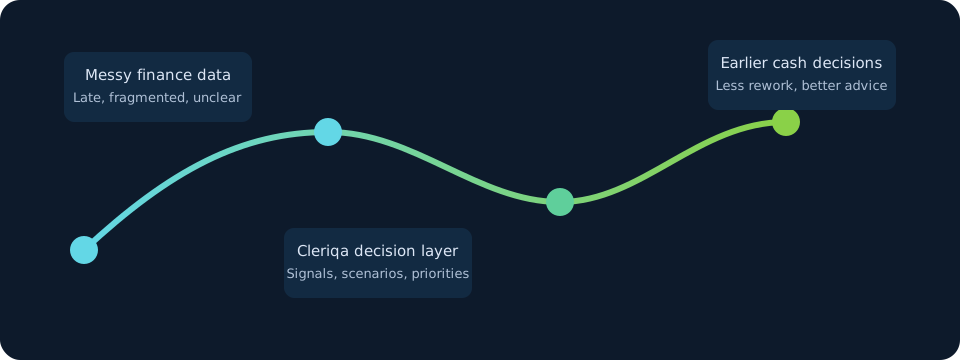
Built by Onwards Capita, Cleriqa combines the judgment of a veteran CFO with predictive analysis and agentic infrastructure. The result is a platform that turns messy accounting data into trusted liquidity insight, action plans, and scenario decisions for SMEs, while helping accounting firms expand advisory revenue and protect margins.
The solution was born from two complementary disciplines.
Frédéric Vérin brought the CFO operating lens: years of finance leadership, restructuring, M&A, fundraising, cash management, and working-capital execution across SMEs, scale-ups, and complex operating environments.
Rahul Balaraman brought the technical engine: predictive analysis, agentic workflows, and infrastructure designed to turn messy financial inputs into structured, explainable outputs.
Together, we built Cleriqa around a practical question:
“What if every SME could access the kind of liquidity guidance normally reserved for companies with a senior CFO, and every accounting firm could deliver that guidance profitably?”
That is the reason Cleriqa exists.
Not to replace accountants.
Not to replace CFOs.
Not to add another dashboard.
But to turn accounting data into trusted decisions and to make those decisions available before cash pressure becomes a crisis.